

Core themes explored
Existence gives and takes without preference, on its own time. The flame that cooks a meal razes a hillside, and neither act carries a verdict until we hand it one.
Sealed systems manufacture the harm they fear. A century of fire suppression stacked the fuel for catastrophe, while the Karuk’s small, seasonal burns keep pace with fire’s own timing and call the forest back. The body tells the same story, generosity in a healing wound, autoimmune collapse when the loop seals shut.
Beneath the fire and the wound, three movements hum like a bassline: Generosity, Resonance, Harmony. We invent none of them. We clear the dry brush of the mind until what already hums comes through.
What we attend to primes what we find. An older, faster layer reads the room before the thinking mind arrives, so a person schooled in love and a person braced for fear can wake to one morning as two different worlds.
Voices in the piece: Lao Tzu, Heraclitus, the Karuk, Chögyam Trungpa, Bruce Lipton, and Lisa Feldman Barrett.
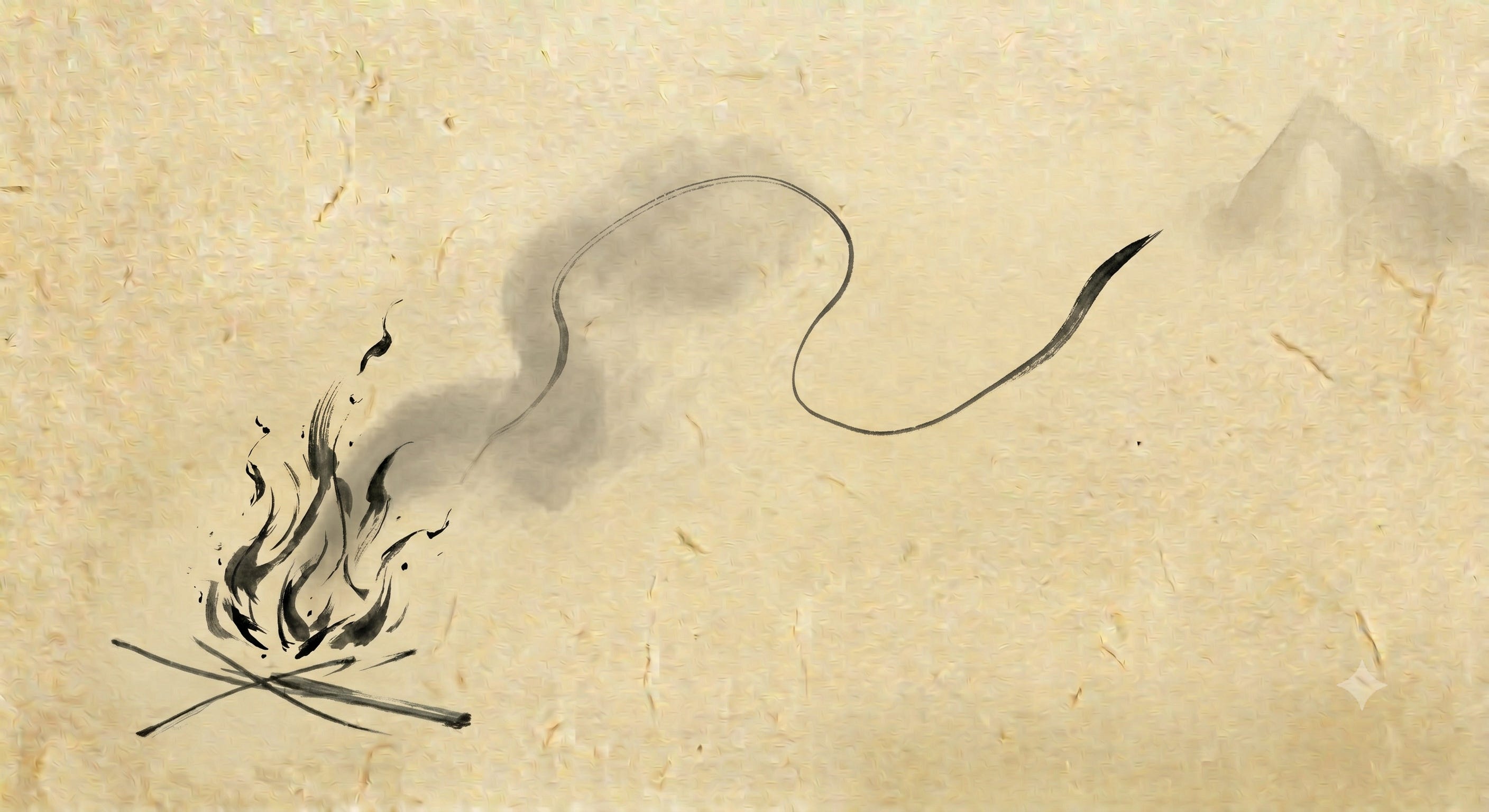
Heaven and Earth are impartial
And regard myriad things as straw dogs.¹
— Lao Tzu, Tao Te Ching
Campfires don’t care what we call them.
We learn this young if we’re lucky. My family learned it across Wisconsin summers throughout the 1990s, hauling a canvas tent that grew mold if we rolled it too soon. Green stains bloomed along the seams. The canvas apparently harbored its own opinions about timing.
Once the mold had its way, our family graduated to a Palomino pop-up camper. The camper carried a horse’s name but dragged at the speed of a packed cinderblock equipped with rusty rollers. Our dad hitched it to the red Ford Aerostar as we hauled it across the country, the trailer gently swaying along the curves. The backseat smelled fiercely of bug spray and sunscreen, curiously blended with the wafting ghosts of loaded diapers – a biological mystery considering the youngest of us had been potty-trained for a few years.
That Aerostar and Palomino duo saw a lot.
Lake Michigan’s sandy dune shoreline one summer. The Gulf of Mexico the next. Lake Superior buttressing Michigan’s Upper Peninsula on another. We just call it the U-P, or, if you’re local-ish, da U-P. That lake does not care about your vacation. It holds the temperature of a wronged ghost trapped by sheets of melting glacier. You do not swim in it so much as survive it, emerging blue-lipped, entirely awake, and stripped of whatever petty grievances you carried into the surf.
Then the big family trip to the rim of the Grand Canyon where we stood at the edge as the silence held us... until the grind of someone’s Kodak disposable broke the spell. We endured that mechanical kkhhhk-kkhhhk-kkhhhk of the film advance, because even awe had to wait for the winding.² The winding ground to a halt as we descended into the canyon, trading the mechanical obligation of capturing the moment for the staggering, silent weight of actually walking inside it.
The hills of Kentucky, where our Aerostar’s transmission finally surrendered to the Palomino’s weight against the endless rolling grades, stranded us for two days in a dry county. Us kids, ecstatic about our surprise hotel cable TV and chlorinated pool. Our parents, quietly calculating the grim math of unplanned automotive repair without the anesthesia of a single beer to wash it down.
We recovered, and the next year off we went to the Badlands of South Dakota, where the landscape looks like the earth tried to turn itself inside out and got halfway before losing interest. My brother and I found an arrowhead there, knapped by a hand long before our minivan ever rattled past. Lives attended to that ground for ages before our family trip crossed its path. The Badlands keep the whole record and cling to nothing.³
We found our way back to northern Wisconsin and the UP. We treated that rugged peninsula as our own. It stands as a wild, pine-choked territory geographically grafted to Wisconsin but legally kidnapped by Michigan over a forgotten border dispute involving Toledo. We claimed its wilderness anyway.
Across the years and state parks, every campsite starts with ritual. Gather kindling. Stack the logs. Strike the match. Then have a pause. The flame catches, and the circle of faces leans in, because warmth pulls us closer before thought does. Nobody tells us to lean. The fire warms whoever sits close. It burns because fire burns.
We happily submit to the ritual. Lao Tzu once compared all of creation to straw dogs: small woven figures used in ancient ceremonies and discarded once the ritual ended. We are those straw dogs, fully participating in the ceremony of living. We gather around the heat, entirely present before the moment passes and the earth reclaims us. The fire simply reminds us of our place in the sequence.
We lean in because we intuitively understand something fundamental: existence operates with a blind, generous neutrality according to its own time. Conditions and circumstances constantly change, but the underlying essence of existence remains. Heraclitus saw the cosmos as one ordering, the same for all: “fire everliving, kindled in measures and in measures going out.”⁴ To the universe, he observed, “all things are fair and good and just, but humans have taken some things unjust, others as just.”⁵ The flame holds no malice and plays no favorites. The fire remains entirely indifferent to acting as a savior or a destroyer. We assign the role.
That neutrality follows us home. The stovetop flame that cooks breakfast. The candle on the kitchen table during a power outage. We call it “cozy” around the campsite and “dangerous” in the headlines. Fire remains the same between those two sentences. Our attending turns the meaning.
They [the Karuk] treat fire as medicine. They read the flame’s tempo the way a musician reads a rest between phrases, attending to fire’s eigenzeit: nature’s own timing, the pace inherent to a process that resists being hurried beyond its own happening.¹¹
For over sixty years, the United States built a policy around a single, hardening assumption: fire destroys.
The Great Fire of 1910 burned three million acres across the Northern Rockies and killed nearly eighty people.⁶ Congress responded with the Weeks Act the following year, establishing a framework for cooperative firefighting and federal purchase of forest lands.⁷ By 1935, the Forest Service had codified its “10 a.m. policy”: any wildfire spotted had to be suppressed by ten the next morning.⁸ The label hardened into infrastructure. Watchtowers. Roads. Budgets. Smokey Bear.⁹ An entire professional identity organized around a single premise.
The system projected coherence from the inside: suppress the flame, protect the timber. For decades, it looked wildly successful.
Yet the undergrowth kept building. Dead leaves, fallen branches, and dry brush accumulated on the forest floor, a century of fuel waiting in the wings because the small fires that clear the ground never received permission to burn. The sealed system, well-intentioned but driven entirely by the fear of losing control, manufactured the conditions for heightened catastrophe it claimed to prevent. When the fires finally arrived – as the sky-darkening, megadrought-fueled infernos we have witnessed over the last decade painfully remind us – they swept through uncontainable. They burned hotter, faster, and more violently than anything the pre-suppression forests encountered. We tried to legislate nature to protect ourselves, and in doing so, we built our own pyre.
The suffering tells us what the well-intended policy missed. Fortunately, nature also suggests pathways to repair.
Step into the Klamath River basin, and we see Indigenous peoples working with fire for millennia. The Karuk of Northern California practice cultural burning: small, intentional, seasonal.¹⁰ They treat fire as medicine. They read the flame’s tempo the way a musician reads a rest between phrases, attending to fire’s eigenzeit: nature’s own timing, the pace inherent to a process that resists being hurried beyond its own happening.¹¹
And fire answers them. Certain pinecones crack open only in extreme heat, spilling seeds that waited years for the burn to free them. The fire that clears the floor is the fire that calls the forest back. Their forests thrive because they move with the grain of what fire already does. Nature tends toward harmony, in its own time.
Even so, the forest keeps part of itself hidden. How flame and seed and soil answer one another runs deeper than anyone traces, the Karuk included. We move with the pattern without seeing all of it. Heraclitus said the hidden attunement is better than the obvious one,¹² and we can let the unseen part stay unseen.
One system sealed itself around a label and stopped listening: it severed its relationship with the natural pattern. The other kept the conversation going. You can read the difference in the smoke.
The pattern plays inside our bodies, too.
Inflammation begins as generosity. A cut on the hand, a twisted ankle, a virus crossing the threshold. The damage calls, and the body answers with everything it has: blood, white cells, and heat rush toward the wound. The swelling that aches is the swelling that mends. Our body pours its resources toward repair, performing its deepest biological imperative. It does exactly what it evolved to do.
Like fire, inflammation mobilizes, protects, and restores without consulting our moral categories. The response ignores “good” and “bad.”
The trouble arrives when that inflammatory cascade loses contact with the larger system and turns its generous attention into overabundance lacking discernment. The restoration efforts lose their harmony. Resonance rings flat. When the immune system floods the body without reading the whole room, it disrupts the very restoration it set out to perform. The body begins attacking its own tissue. Joints swell against cartilage that belongs there. The gut lining erodes under friendly fire. The immune system builds its own closed loop, resonant within its sealed perception, responding to threats that exist only inside the seal.
We feel the misalignment before any diagnosis arrives. The fatigue that won’t lift. The ache that wanders without locating itself. That low hum of a system running against its own grain. The body knows first. The discord builds on its eigenzeit, beneath our awareness, until the signal finally breaks the surface.
Two patterns, then. One outside the skin, one inside. Fire and inflammation. Both neutral in their original motion. Both generous. Both capable of destruction when sealed off from the larger pattern they belong to.
In Lifelook, I call the ground beneath these patterns Nature’s Values: three movements that recur like the bassline of existence.¹³
Generosity: nature’s intrinsic givingness. Purpose moving from within, potential offered without demand. The fire warms before we ask. The body repairs before we decide.
Resonance: existence vibrating in relationship, where patterns respond to patterns and meaning arises in the space between. The forest and the fire reading each other. The immune cell and the tissue it protects, joined in mutual recognition.
Harmony: the confluence of opposites where difference generates unity through motion. Burn and regrow. Inflame and heal. Day listening into night, a joining that deepens both.
Generosity moves first among the three. The potential it offers, freely and without demand, is what lets patterns find one another and settle, in their own time, into harmony. The gift precedes the accord it makes possible.
These three underpin our whole existence, the conditions we inhabit simply by being here. Attune to them, and we feel the alignment. Cut against them, and we feel the cost. We don’t manufacture resonance or engineer harmony or produce generosity. We clear enough debris away to find them already humming.
This clearing mirrors the Karuk’s cultural burn. We intentionally tend the ground, allowing small, daily fires of awareness to burn through our accumulated mental dry brush. When we refuse to clear this internal undergrowth, when we legislate our inner state like the Weeks Act, suppressing every uncomfortable spark to protect ourselves from feeling, the fuel builds. We manufacture our own emotional inferno.
Nature’s values carry no inherent moral weight. They hum the way gravity pulls: neutrally. Our attending, our agency, and our choices supply the direction, the coloring, and the weight. Generosity underwrites both the Karuk’s cultural burn and the Forest Service’s century of suppression. The difference lives in ways of attending to the resonance and harmony between them.
A fair contradiction surfaces here. If these forces stay neutral, why does nature keep settling toward balance? It does settle. Cut against resonance and harmony, and the strain burns out, and the pattern finds its level again. But a tendency is not a preference, and neutral was never the same as directionless. Gravity prefers nothing, yet it rounds every star, a fierce and reliable pull that favors no one.¹⁴ Its even hand spares none. It breaks the fragile thing as readily as the stone, and impartial and unforgiving turn out to be one property, not two.
Nature leans toward coherence with the same fierce reliability, a pull and not a wish. And the coherence it reaches stays neutral. The Forest Service’s suppression settled into one kind of order. The Karuk’s burning settles into another. Both are balance. Which one, and whether it gives life or takes it, is the part we supply.
We don’t add our way to the living one. We clear our way there, the way the Karuk clear the forest floor, until what was always humming underneath comes through.¹⁵
We intentionally tend the ground, allowing small, daily fires of awareness to burn through our accumulated mental dry brush. When we refuse to clear this internal undergrowth, when we legislate our inner state like the Weeks Act, suppressing every uncomfortable spark to protect ourselves from feeling, the fuel builds. We manufacture our own emotional inferno.
Let’s pull up a chair at the attending table. The coffee grinder howls. The toaster ejects a slightly charred bagel. The dog stares at the drywall, actively decoding a frequency we cannot hear. We sit down amid this domestic clatter and immediately begin sorting the universe into neat little boxes. The Tibetan Buddhist teacher Chögyam Trungpa once observed that wisdom is ultimately “a domestic affair.”¹⁶ That phrase keeps proving itself right here, over the breakfast crumbs.
We label things “good” and “bad” a hundred times before lunch. The traffic. The text that could mean anything, though we’ve already decided what it means. The weather. The look on a colleague’s face that we’ve interpreted, filed, and responded to before the elevator reaches our floor. Each label is a small act of attending, and each one seeds the next encounter.
Much like those Karuk pinecones requiring the intense heat of the flame to crack open, some of our most abundant encounters require the friction of an uncomfortable moment to release their insight. When we lean into the heat rather than label it a threat, we allow the seeds to spread and do their growing. We co-create the world we inhabit through these micro-choices, most of them running under the floorboards of our awareness.
Beneath those floorboards, some older, faster part of us scans the world before the conscious mind finishes the updates. The cell biologist Bruce Lipton captures the speed of this shaping: the subconscious mind reads every word on a newspaper page before our conscious mind finishes unfolding it.¹⁷ The neuroscientist Lisa Feldman Barrett finds this in the brain itself, which runs as a continuous prediction engine, drafting the world a half-step before it arrives.¹⁸ What the brain flags depends entirely on what we have primed it to find.
A person living in love moves toward love wherever it sits on the page. A person living in fear spots threat in every headline. One newspaper. One morning. Two entirely different worlds.
What we attend to today adds a brushstroke to the painting we wake up inside tomorrow. Much of the painting, we inherit. Some of it, we choose. The question sits with how much of the choosing happens with our eyes open.
Our choosing determines whether we fight the breakdown or sit by the pool without a beer.
Our family trips graduated from that moldy canvas tent to the Palomino, hauled by a van destined to blow its transmission under the pressure of the Kentucky hills. The breakdown was unplanned, deeply inconvenient, and entirely inevitable. Yet, paying for that unexpected repair mid-trip forced an unplanned pause. It allowed us to tend to those new circumstances with a freshly cleared mind. We pulled up a plastic chair at the chlorinated motel swimming pool. We marveled at the staggering abundance of basic cable TV, realizing it offered infinitely more than the five channels we received at home (this was the mid-1990s, remember). The breakdown arrived uninvited. Our attending shaped the memory of it.
Campfires ignore what we call them. They burn because burning is what fire knows. The warmth I felt leaning in on those Wisconsin nights, faces lit and shadows cast long behind me, had already arrived. It offered its heat before I asked, disregarding my gratitude and my fear alike. The fire never knew us. What hums beneath it might.
What are we primed to find? Does our attending move with the grain of how life already holds together, or against it? The bassline hums either way. It always has.
Long live that Palomino.

For more on Nature’s Values and the Lifelook philosophy: https://lifelooknow.com/natures-values
Summary: Reality operates with an open, generous neutrality. It tends toward balance yet holds no preferences as it keeps its own time. Our attending dictates the rest. How we choose to perceive, prime, and respond to the world determines whether we flow with the grain of existence or manufacture our own suffering. To live well is to move as the field of change itself, feeling it, questioning it, and following it with care. When we stop suppressing the small, daily fires and begin attuning to their eigenzeit, we cease fighting the breakdown. We see nature’s inherent generosity and can rest within its movement.
Notes
*Fire Image: Image generated with Gemini AI assistance based on the author’s design direction.
Lao Tzu, Tao Te Ching: Annotated & Explained, trans. and annot. Derek Lin (Woodstock, VT: SkyLight Paths, 2006), chap. 5. “Myriad things” is also translated as The Ten Thousand things, which essentially means all of things that make up our universe that we see and experience. Straw dogs are small dog figurines made from straw. They were used in ancient times for rituals and then discarded after use.
Some families have heirlooms. We have memorylooms, stitched together through a pop-up camper with a car-top carrier that rattled and Kodak disposables with twenty-seven exposures held by a prayer they’d capture the trip. The gear was never the treasure. The days were. A rattling carrier and a disposable camera hold nothing on their own, and both are long gone now. They were vehicles toward the experience, and the experience is the part that stayed. We hold the objects lightly because the memory is what we keep, and the smallest thing can conjure it back, the way a smell drops you into your grandmother’s kitchen thirty years later, or the back seat of an Aerostar.
The Badlands keep a calendar. Wind and water lay each layer down in order, and erosion reads them back to us, stratum by stratum, tens of millions of years legible in the rock. The arrowhead belongs to that record too, a life pressed into the ground and surfaced without ceremony. What the land never does is hold on. It carries the dead forward in stone and grieves none of them, stacks the eons and favors no single one. This posture turns up everywhere once you start looking: the straw dogs honored in the ritual and released after, the balance that remains only as residue, the generosity that gives and asks for nothing back.
Heraclitus, fragment XXXVII in Kahn’s arrangement, which is B30 in the standard Diels-Kranz numbering. Kahn renders it: “The ordering (kosmos), the same for all, no god nor man has made, but it ever was and is and will be: fire everliving, kindled in measures and in measures going out.” Charles H. Kahn, The Art and Thought of Heraclitus (Cambridge: Cambridge University Press, 1979; repr. 2001), text 45, commentary 132. Kahn reorders the fragments under his own Roman numerals, so they differ from the Diels-Kranz figures readers may know.
This line on human categories is attributed to Heraclitus from secondary sources. See fragment LXVIII (DK B102). Charles H. Kahn, The Art and Thought of Heraclitus(Cambridge: Cambridge University Press, 1979), Kahn LXVIII, text 61, commentary 183.
The Great Fire of 1910, also known as the “Big Burn,” swept across Idaho, Montana, and Washington in a 36-hour firestorm. It remains one of the largest wildfires in American history. See Stephen J. Pyne, Year of the Fires: The Story of the Great Fires of 1910 (Missoula, MT: Mountain Press Publishing, 2008); Timothy Egan, The Big Burn: Teddy Roosevelt and the Fire That Saved America(New York: Houghton Mifflin Harcourt, 2009).
The Weeks Act, signed by President William Howard Taft on March 1, 1911, authorized federal purchase of forest lands and established the first framework for cooperative fire control between federal and state authorities. It laid the foundation for the National Forest System in the eastern United States. See “1911 Weeks Act: The Legislation that Nationalized the U.S. Forest Service,” Forest History Society, https://foresthistory.org.
U.S. Forest Service Chief Ferdinand Silcox issued the directive in May 1935, calling for “fast, energetic, and thorough suppression of all fires in all locations.” The policy was formally abandoned in 1978 in favor of approaches that recognized fire’s ecological role, though its influence persists. See “U.S. Forest Service Fire Suppression,” Forest History Society, https://foresthistory.org/research-explore/us-forest-service-history/policy-and-law/fire-u-s-forest-service/u-s-forest-service-fire-suppression/.
Smokey Bear debuted in 1944 as part of the Forest Service’s fire prevention campaign. His slogan, “Only You Can Prevent Forest Fires,” became one of the most recognized public service messages in American history. As a campaign, it worked, and it prevented countless careless fires. Whether the larger policy it served stayed in tune with the forest is another question.
The Karuk Tribe, whose traditional homelands sit along the middle Klamath River in Northern California, have practiced cultural burning for millennia. The Karuk word pikyavmeans “to fix,” and cultural burning is understood as a form of land repair and spiritual responsibility. The passage of the Weeks Act in 1911 effectively made cultural burns illegal, a policy the Karuk have spent over a century working to reverse. In 2025, California and the Karuk Tribe established a groundbreaking agreement under Senate Bill 310, empowering Karuk cultural fire practitioners to conduct burns under Traditional Ecological Knowledge. See “California Partners with Karuk Tribe on Groundbreaking Cultural Burning Agreement,” Karuk Tribe Press Release, February 2025, https://www.karuk.us.
Eigenzeit (German: “own time” or “proper time”) refers to the time inherent to a process. The term originates in physics, specifically Einstein’s special relativity where it denotes the proper time measured by a clock moving with an observer, but it has found a second life in philosophy, ecology, and social theory, wherever a process keeps its own counsel. Bread rises when bread rises. A two-year-old puts on shoes when the two-year-old puts on shoes. Forests burn when forests need to burn.
Heraclitus, fragment LXXX in Kahn’s arrangement, which is B54 in the standard Diels-Kranz numbering. Kahn renders it “the hidden attunement is better than the obvious one.” Charles H. Kahn, The Art and Thought of Heraclitus(Cambridge: Cambridge University Press, 1979; repr. 2001), text 65, commentary 202. Kahn admired it as one of the shortest and most finely built of the fragments: four Greek words, the unseen (aphanēs) set against the seen (phanerēs), with kreittōn, “stronger” or “better,” perhaps tipping the weight toward what stays hidden. I have come to find some comfort in that. We don’t need to see all of it for the attunement to hold, and accepting our ignorance becomes its own quiet harmony.
I explore Nature’s Values more fully at lifelooknow.com/the-books. The framework draws on the Platonic triad: Truth, Beauty, Goodness, brought closer to the body: Truth lives as Resonance felt, Beauty as Harmony unveiled, Goodness as Generosity embodied.
We say pull because that is how it feels, but Newton's force was only ever the first draft. Einstein, in 1915, found something stranger and so far more accurate: mass and energy curve the geometry of spacetime, and what we feel as a pull is really objects following the straightest path available through that curving. No hand reaches out. The Earth does not tug the moon so much as bend the space the moon coasts through. Things fall because the ground leans that way. The felt weight survives the reframing. The metaphysics under it changes entirely, from a hand to a hollow. Which, for an essay about ground, is a quiet gift: nothing pushes us toward coherence. It is simply downhill.
The deepest traditions treat this clearing as an uncovering. The Sanskrit moksha and the Japanese Zen satori both point toward release rather than acquisition: you stop generating the noise that hides the ground, and what remains was always there. The via negativa of the Christian contemplatives and the neti neti (”not this, not this”) of the Upanishads name by removing. Balance, in this light, is less a place we arrive than a hum we stop drowning out.
The Tibetan Buddhist teacher Chögyam Trungpa observed that wisdom is ultimately “a domestic affair.” The full context of his observation lands even harder than the excerpt: wisdom verified in oneself, tested in the dailiness of living, then brought back to the world. The kitchen counts. See Chögyam Trungpa, The Myth of Freedom and the Way of Meditation, ed. John Baker and Marvin Casper (Boulder, CO: Shambhala Publications, 1976), 93.
Cell biologist Bruce Lipton captures the speed of this biological shaping. His broader work on cellular biology and perception, particularly The Biology of Belief(Carlsbad, CA: Hay House, 2005), explores how our beliefs govern biological response at the cellular level. The newspaper metaphor captures something his research corroborates: what we attend to determines what we encounter, often before we realize we’ve chosen.
Lisa Feldman Barrett’s extensive research on constructed emotion demonstrates that our brains continuously predict and construct our reality rather than merely reacting to it. I explore how this predictive machinery shapes our daily agency, and how we might interrupt it, in another essay, “The Dangled Pause Option.” See lifelooknow.com/attending-the-days/f/the-pause-before-responding.
Thank you for this beautiful piece, and for introducing me to the term ‘eigenzeit’. These lines really struck me:
They read the flame’s tempo the way a musician reads a rest between phrases, attending to fire’s eigenzeit: nature’s own timing, the pace inherent to a process that resists being hurried beyond its own happening.
I have been spending extended periods of time alone on the land where I live, intentionally deepening, slowing to the point of discovering my own eigenzeit. When I do, it often feels like a becoming of your three terms: generosity, resonance and harmony. I wonder if this is down to some kind of reciprocal tuning of inner and outer nature of which I am only dimly aware.